
The End of the Debt Imperative, toward a Net Savings Economy
We stand at the precipice of a fundamental misunderstanding of money itself. For generations, the economic orthodoxy has been governed by a singular, relentless logic: the logic of debt. Sovereign states, in order to provision for their citizens and build essential public goods, have been forced to become perpetual borrowers in their own currency, pledging future tax revenues to private financial markets in a cycle of endless interest payments. This system, we are told, is immutable. It is not. It is a relic, an obsolete monetary regime of a bygone era, and it is collapsing under the weight of its own contradictions.
The architecture presented herein is not merely a proposal for a Universal Basic Income. It is the blueprint for a new sovereign monetary covenant. It severs the chain that binds public purpose to private debt. It proposes a radical yet simple axiom: a monetarily sovereign state, possessing a fiat currency and a central bank, need not issue debt to provision itself for the well-being of its citizens. It can instead issue currency directly, anchored not to the speculative whims of bond markets, but to the productive capacity of the nation itself—its people, its infrastructure, and its future. This is a fundamental reimagining of the UK’s social contract, using digital sovereignty to create a more resilient, equitable economic system for the future of Britain.
The Architectural Core: A Trinary Foundation for a New Economy
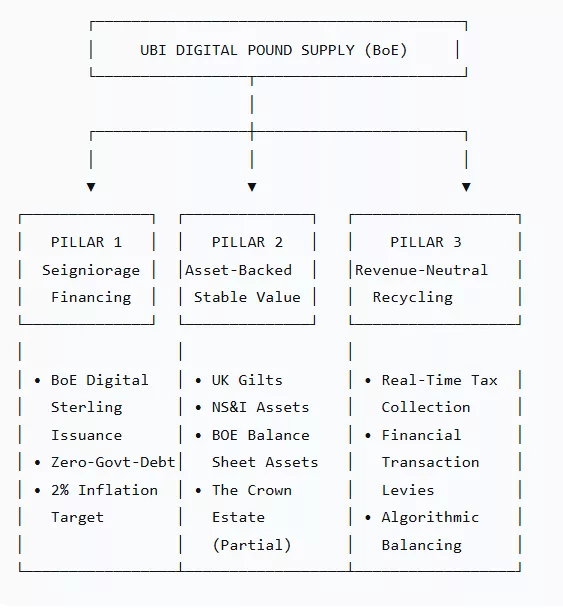
The entire edifice rests upon a revolutionary Three-Pillar Funding Model, designed to ensure stability, trust, and sustainability. The first pillar, Seigniorage Financing, harnesses the Bank of England’s power to issue Digital Sterling. This is a conscious exercise of monetary sovereignty, creating currency for public purpose under a strict 2% inflation target, fundamentally achieving Zero-Govt-Debt for day-to-day spending. It is not a hidden process but a transparent, rule-based operation.
The second pillar, Asset-Backed Stable Value, provides the tangible anchor for this new system. It transforms the Bank’s existing balance sheet—comprising UK Gilts, NS&I Assets, and other public holdings—from a technical ledger into a bedrock of public equity. The strategic inclusion of partial backing from The Crown Estate further roots the currency in the nation’s long-standing physical assets. This portfolio is not static; it is a managed, diversified foundation that guarantees the UBI Digital Pound is not an abstract promise but a claim on real, sovereign wealth.
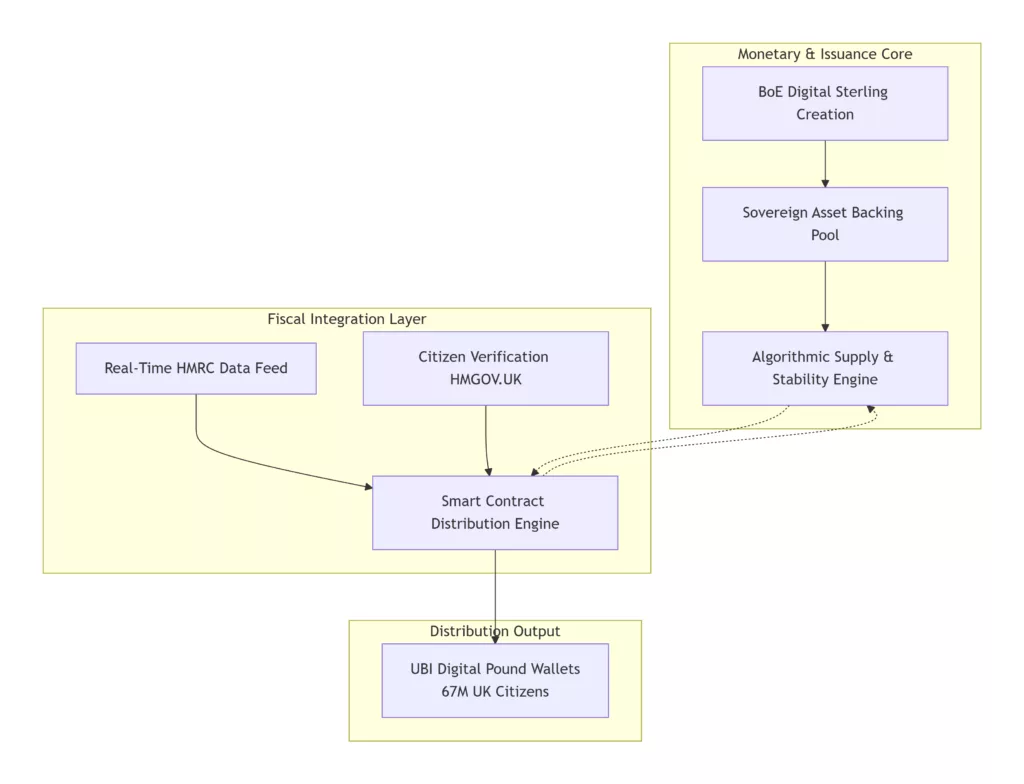
The third pillar, Revenue-Neutral Recycling, is the dynamic engine of equilibrium. It integrates Her Majesty’s Revenue and Customs in a way previously impossible, enabling Real-Time Tax Collection that flows seamlessly alongside economic activity. This is supplemented by minimal Financial Transaction Levies and governed by Algorithmic Balancing mechanisms within the Digital Pound’s core. This creates a closed-loop system where money is issued, circulated, taxed, and recycled, maintaining velocity without triggering inflationary decay. This tripartite structure—sovereign issuance, asset backing, and real-time fiscal recycling—forms an indivisible, self-stabilising monetary circuit.
The Operational Nexus: Governance and Technology in Symbiosis
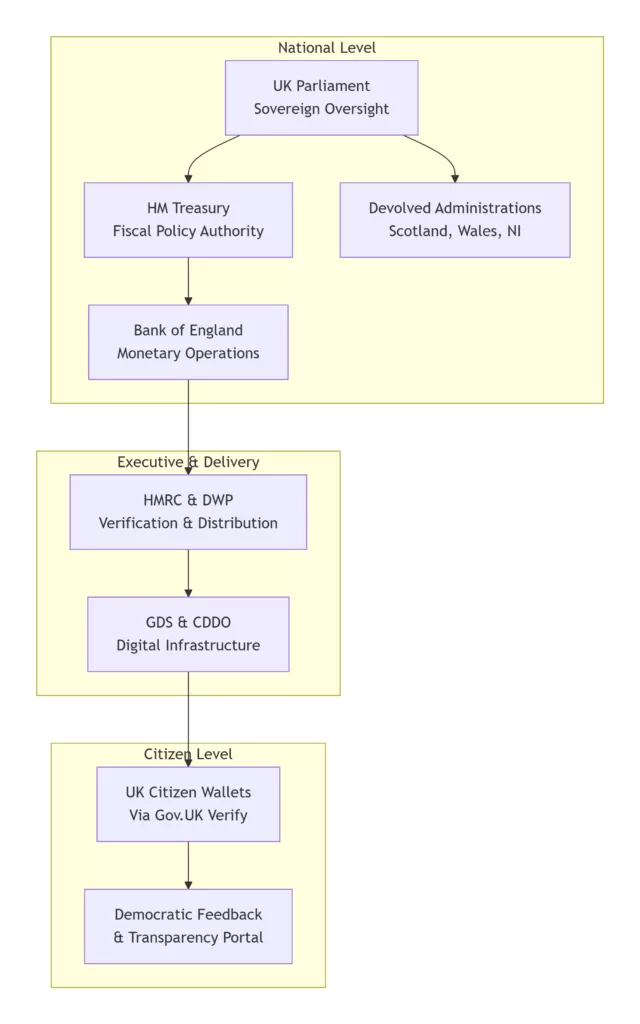
The implementation of this covenant requires a UK-specific governance Architecture that respects the nation’s constitutional fabric. Parliamentary Sovereignty is paramount; the UK Parliament, as the supreme legal authority, provides the ultimate oversight and mandate, a clear advantage over federalist architectures such as the United States. This sovereignty is exercised with nuance through a Multi-Level Governance Architecture that actively incorporates the Devolved Administrations of Scotland, Wales, and Northern Ireland. This is not a centralised imposition but a union of nations, with mechanisms for regional cost adjustments and implementation tailored to local economic realities.
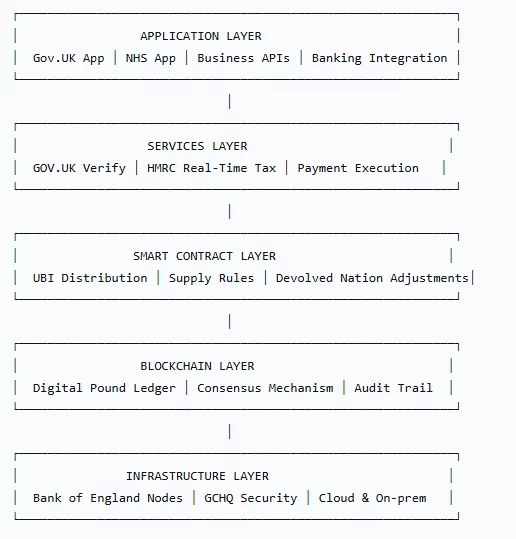
Beneath this political structure lies the robust Technical Infrastructure Stack. The foundational Blockchain Layer—the Digital Pound Ledger—provides an unalterable audit trail and consensus mechanism for every transaction. Upon this rests the Smart Contract Layer, where the logic of society is encoded: the UBI Distribution schedules, the Supply Rules for managing inflation, and the adjustments for devolved nations. The Services Layer integrates the state’s digital backbone, leveraging GOV.UK Verify for secure identity and HMRC’s systems for Real-Time Tax data, all coordinating Payment Execution. Finally, the Application Layer delivers this power directly to citizens through the Gov.UK App, the NHS App, and Business APIs, ensuring Banking Integration and universal accessibility. This entire stack is secured by Bank of England Nodes and protected by GCHQ Security, operating across resilient cloud and on-premise infrastructure.
The Economic Metamorphosis: From a Debt-Based to a Savings-Based Economy
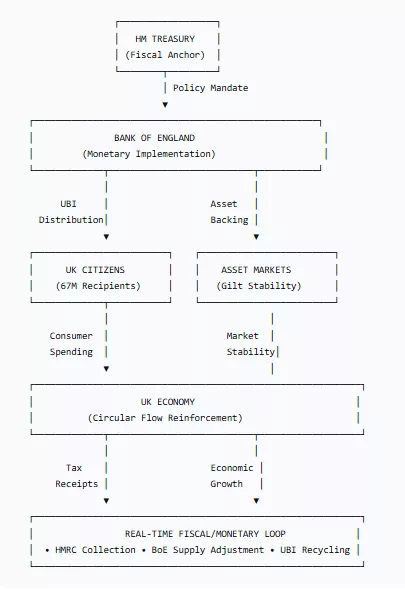
The most profound transformation occurs in the UK Economic Flow Model. The old, linear model of state debt issuance, crowding out private investment, is replaced by a circular, reinforcing flow. The process begins with HM Treasury setting the fiscal anchor through a Policy Mandate. The Bank of England then executes the Monetary Implementation, conducting UBI Distribution to the 67 million citizen-recipients, backed by the Asset Backing pool that ensures Gilt Market Stability.
This is where the metamorphosis begins. Citizens, endowed with economic security, engage in Consumer Spending that directly fuels the UK Economy. This activity generates both Tax Receipts and robust Economic Growth. These two outputs feed directly into the Real-Time Fiscal/Monetary Loop, where HMRC Collection and BoE Supply Adjustment work in concert to recycle and recalibrate the UBI, creating a perpetual cycle of circulation and stability. This model engineers a phase shift from a debt-based to a savings-based economy. By halting the state’s absorption of private savings through gilts, it unleashes a torrent of capital into the real economy. The private credit market, freed from the crowding-out effect of government borrowing, can expand exponentially to fund small business loans, green energy projects, and housing construction. The citizen, endowed with genuine economic security, becomes an agent of capital formation, reducing reliance on predatory debt and building a nation of savers and investors.
The Path to Implementation: A Deliberate and Measured Journey
The transition to this new system is not a sudden leap but a deliberate, five-phase journey outlined in the Implementation Timeline. The Foundation phase, spanning one to two years, is critical, focusing on the Digital Pound Act, the expansion of the BoE’s mandate, and the technical build. This is followed by Regional Pilots in Glasgow, Cardiff, Birmingham, and Cornwall, testing the system with 200,000 participants and integrating HMRC’s real-time data feeds.
The Nationwide Rollout across three to five years will be a phased expansion by region and age cohort, ensuring Full HMRC Integration and Devolved Administration Coordination. This builds towards Full System Maturity, achieving complete coverage of all 67 million UK citizens and developing predictive economic stabilisation features. The final stage of System Evolution will see the UK become a global standard-setter, with dynamic UBI adjustments and AI-driven economic optimisation.
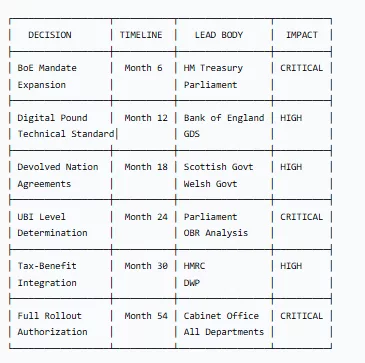
Throughout this journey, the Critical UK Decision Points matrix provides a clear governance roadmap. From the CRITICAL decision to expand the BoE Mandate at Month 6, led by HM Treasury and Parliament, to the technical standards, devolved nation agreements, and the ultimate Full Rollout Authorisation at Month 54, each decision is mapped with clear timelines and accountable bodies.
Vigilance and Engagement: Navigating Risk and Building Consensus
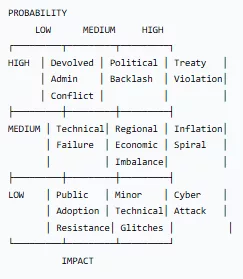
The path is not without its perils, meticulously catalogued in the UK-Specific Risk Matrix. The HIGH probability, HIGH impact risks—Political Backlash and Treaty Violation—must be met with robust stakeholder engagement and legal precision. HIGH impact risks like an Inflation Spiral are mitigated by the very design of the three-pillar model. MEDIUM risks, such as Technical Failure or Regional Economic Imbalance, are addressed through redundant system design and the devolved administration framework.
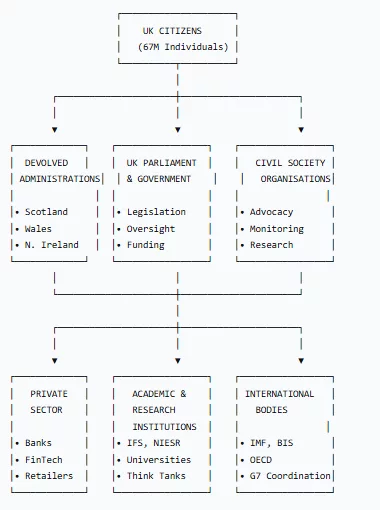
This necessitates a comprehensive Stakeholder Engagement: UK Model. At the centre are the UK Citizens, the primary users and beneficiaries. They are surrounded by a network of essential actors: the UK Parliament & Government for legislation and funding; the Devolved Administrations for local implementation; Civil Society Organisations for advocacy and monitoring; the Private Sector for technology and services; the Academic & Research Institutions for evaluation and innovation; and International Bodies for coordination and best practice. This engagement is fueled by continuous communication and feedback loops, ensuring the system remains responsive and legitimate.
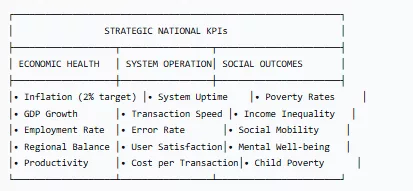
The performance of this entire apparatus is measured by a Performance Monitoring: UK Dashboard, tracking Strategic National KPIs across three domains: Economic Health (inflation, GDP, productivity), System Operation (uptime, transaction speed), and Social Outcomes (poverty rates, social mobility, well-being). This data-driven approach ensures the system delivers on its promises to both the economy and the people.
A Call for Monetary Sovereignty
The choice before us is not one of technical economic management. It is a civilizational choice. Do we continue to be governed by the logic of debt, a logic that concentrates power, fuels inequality, and demands endless growth on a finite planet? Or do we seize the tools of our own monetary sovereignty to build an economy of security, abundance, and purpose?
This proposal is a declaration of monetary independence. It is a recognition that the currency is a public utility, a tool for advancing the common good. The United Kingdom, with its singular sovereignty, advanced digital government infrastructure, strong central bank credibility, and global financial prowess, is uniquely positioned to pioneer this future. The technology to implement it is at hand. The barrier is not technical, but intellectual and political. It requires the courage to imagine a future beyond debt, and the will to build it. The architecture is drawn. The covenant is ready. The future of money is not a promise to pay. It is a capacity to provide.
Futurible Bank of England Digital Sterling UBI: System Architecture Framework
A vision of such transformative scale cannot be realised through a single legislative act or a technological switch. It requires a carefully architected transition, a bridge built from the shores of our current monetary reality to the new world of sovereign, debt-free economic empowerment. The proposed five-phase implementation timeline for a Bank of England Digital Sterling Universal Basic Income is not merely a project plan; it is the concrete pathway for the United Kingdom to consciously evolve its economic operating system. This essay will explore this phased journey, detailing how each stage builds upon the last to systematically de-risk the process, build public trust, and ultimately forge a new social contract founded on monetary sovereignty rather than sovereign debt.
Laying the Cornerstones (Years 1-2)
The Foundation phase is the most critical, for it is here that the legal and technological bedrock of the entire system is established. The primary task is the creation of a new Legal Framework, most notably the “Digital Pound Act.” This legislation would accomplish two monumental shifts. First, it would formally authorise the Bank of England to issue a retail digital currency, a digital pound sterling that exists as a direct liability of the state to its citizens, distinct from commercial bank money. Second, and more profoundly, it would enact a BoE Mandate Expansion, granting the Bank the statutory authority to manage the direct distribution of a Universal Basic Income as a core tool of monetary and social policy, all while maintaining its paramount objective of price stability.
Concurrently, the Technical Build of the Digital Sterling Core Infrastructure begins. This involves constructing the multi-layered architecture previously outlined: the secure Blockchain Layer for the immutable ledger; the Smart Contract Layer programmed with the rules for UBI distribution and supply management; the Services Layer integrating with GOV.UK Verify and HMRC, and the user-facing Application Layer. This is not a proof-of-concept but the construction of a national-scale critical infrastructure, requiring the highest standards of security, likely involving GCHQ from the outset. Alongside this, the Pilot Design commences, strategically selecting 3-4 local authorities that represent the UK’s diverse socioeconomic and geographic landscape, setting the stage for real-world validation.
Three-Pillar Funding Model for UK UBI, Specific Governance Architecture
Proving the Model (Years 2-3)
With the legal and technical foundations in place, the system moves from theory to practice in the Regional Pilots phase. The choice of Test Sites—Glasgow, Cardiff, Birmingham, and Cornwall—is deliberate. It encompasses a major Scottish city, the Welsh capital, a large, diverse English metropolitan area, and a region with unique rural and coastal challenges. This diversity is crucial for stress-testing the system’s adaptability. With a Scale of 200,000 participants initially, the pilot is large enough to generate significant economic and behavioural data but is contained enough to manage risks.
The initial UBI Level of £300-£600 per month is set at a meaningful but not systemically disruptive amount, allowing for the study of its effects on household wellbeing, local business revenue, and labour market participation without triggering macro-scale inflation. A key technical objective of this phase is the Integration and testing of HMRC real-time data feeds. This is the first live test of the crucial “third pillar” of the funding model—the real-time fiscal-monetary feedback loop. The success of this phase is measured not just by technical uptime, but by the quality of data on spending patterns, the public’s comfort with the digital wallet system, and the efficacy of the automated tax-recycling mechanism.
Distributing Sovereignty (Years 3-5)
Bolstered by the empirical evidence and refined systems from the pilots, the Nationwide Rollout begins. This is a period of managed, Phased Expansion, likely by region and age cohort, to smooth the economic impact and manage administrative load. This is not a simple flip of a switch for 67 million people. The most complex technical achievement of this phase is Full HMRC Integration. The real-time tax system moves from a pilot test to the primary governor of the national money supply, dynamically adjusting the net fiscal stimulus of the UBI by clawing back a proportion through taxation as it circulates.
This phase also demands sophisticated Devolved Administration Coordination. The system must be flexible enough to accommodate Regional Cost Adjustments, acknowledging the higher cost of living in London compared to, for example, Northern Ireland. This is where the political and technical architectures intersect, ensuring the union is strengthened by acknowledging its diversity, all within the single, unified technical platform of the Digital Pound.
The Continuous Evolution (Years 7+)
The Full System Maturity phase marks the completion of the initial vision. Complete Coverage of all 67 million UK citizens is achieved, establishing the UBI as a universal right and the Digital Pound as the commonplace medium of exchange. The system now shifts from implementation to optimisation. Advanced Features such as Predictive Economic Stabilisation can be introduced, using the vast, real-time dataset of the national economy to allow the algorithm to anticipate inflationary or deflationary pressures and pre-emptively adjust UBI flow or tax parameters. Furthermore, this phase opens the door for International Coordination with other CBDC systems. As other nations develop their own digital currencies, the UK, as a first mover, can establish protocols for cross-border payments and financial stability, positioning the City of London as a hub for the next generation of global finance, built on sovereign digital money rather than dollar-denominated debt.
The genius of this five-phase timeline is its synthesis of revolutionary ambition with pragmatic, innovative build-up. Each phase is designed to deliver tangible value and de-risk the next, building a compelling narrative of progress. It transforms an abstract economic theory into a manageable series of administrative, legal, and technical challenges. This journey from the Digital Pound Act to global leadership in digital sovereign money represents nothing less than the conscious, deliberate creation of a new economic reality for Britain. It is a testament to the idea that a nation can, with clarity of purpose and technological prowess, choose to write a new chapter in its history—one where money serves the people, and the state is liberated from the tyranny of the debt imperative. The path is clear; it now requires only the collective will to take the first step.