
Your Old China plates’ economy presents a mixed picture for the third quarter, characterised by robust industrial performance and steady GDP growth, but held back by persistent weaknesses in investment and the property market.
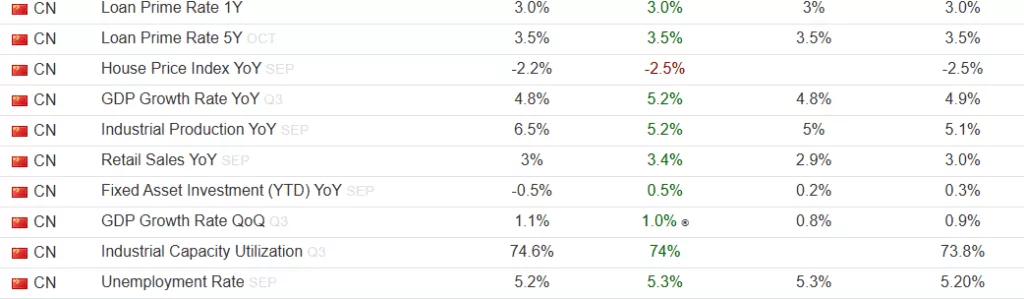
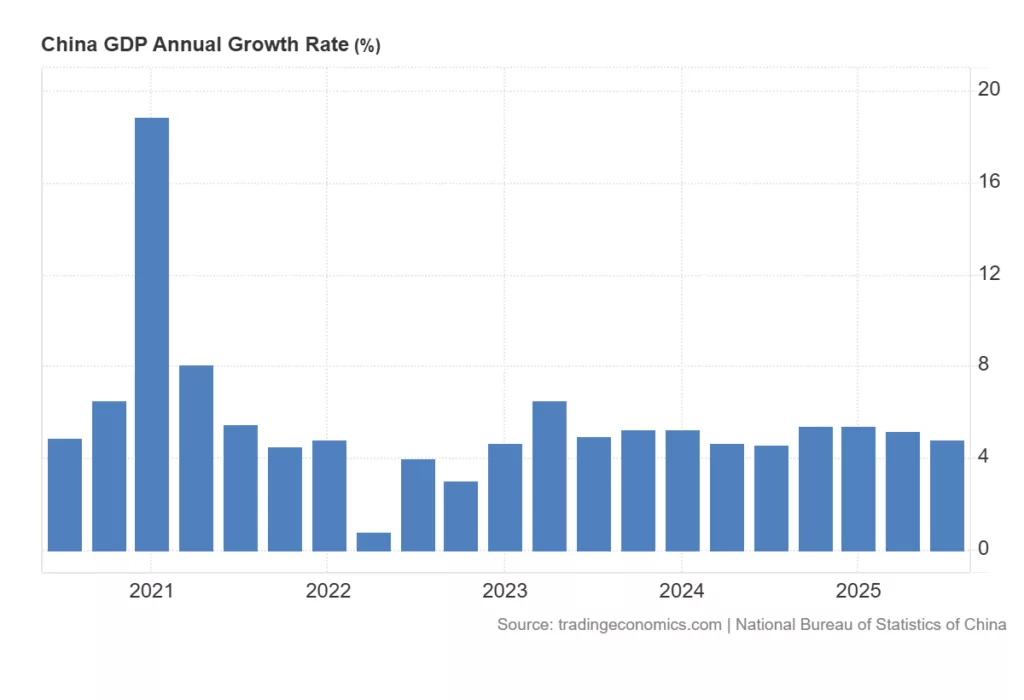
The economy grew at a year-on-year rate of 4.8% in Q3, slightly exceeding the consensus of 4.8%, though this represents a deceleration from the previous 5.2%.
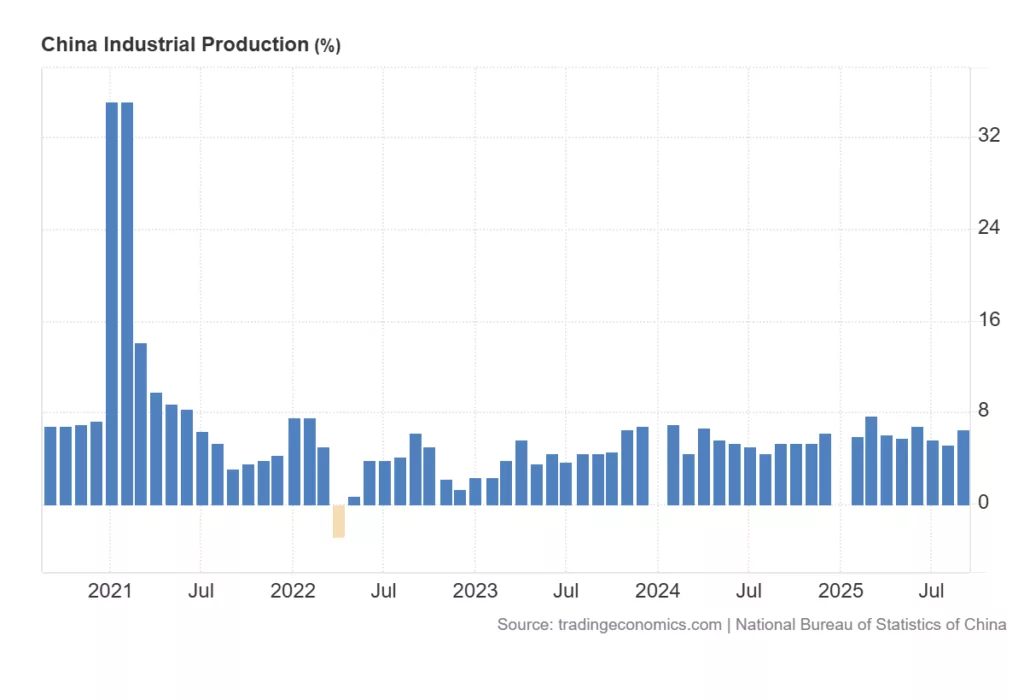
A key bright spot was Industrial Production, which surged to 6.5% year-on-year in September, significantly beating forecasts and indicating strong factory output. However, this industrial strength contrasts sharply with other sectors.
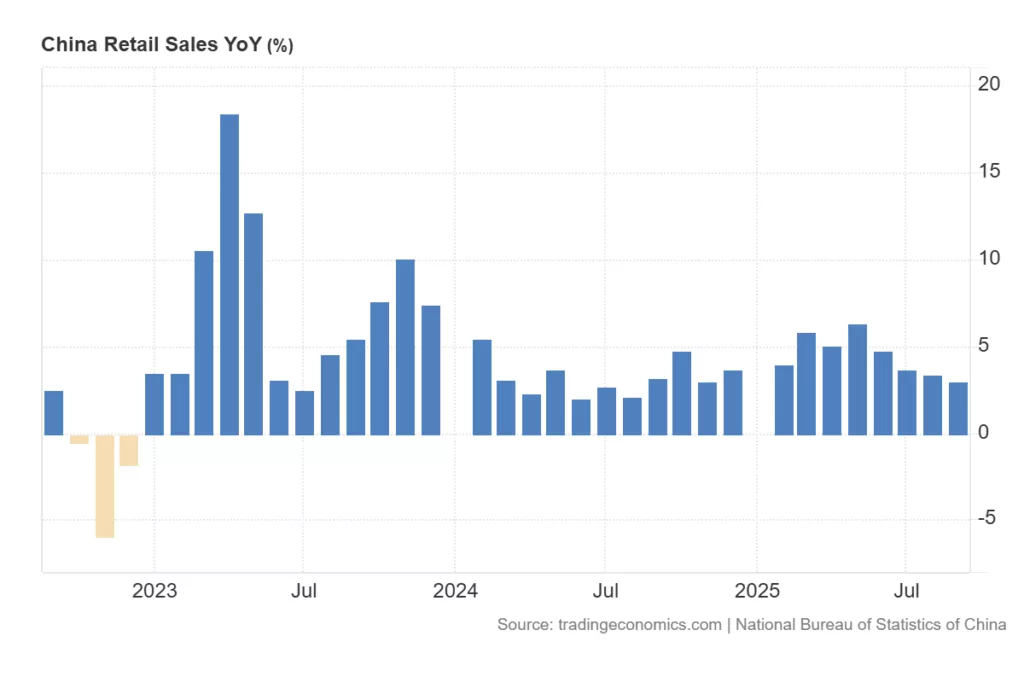
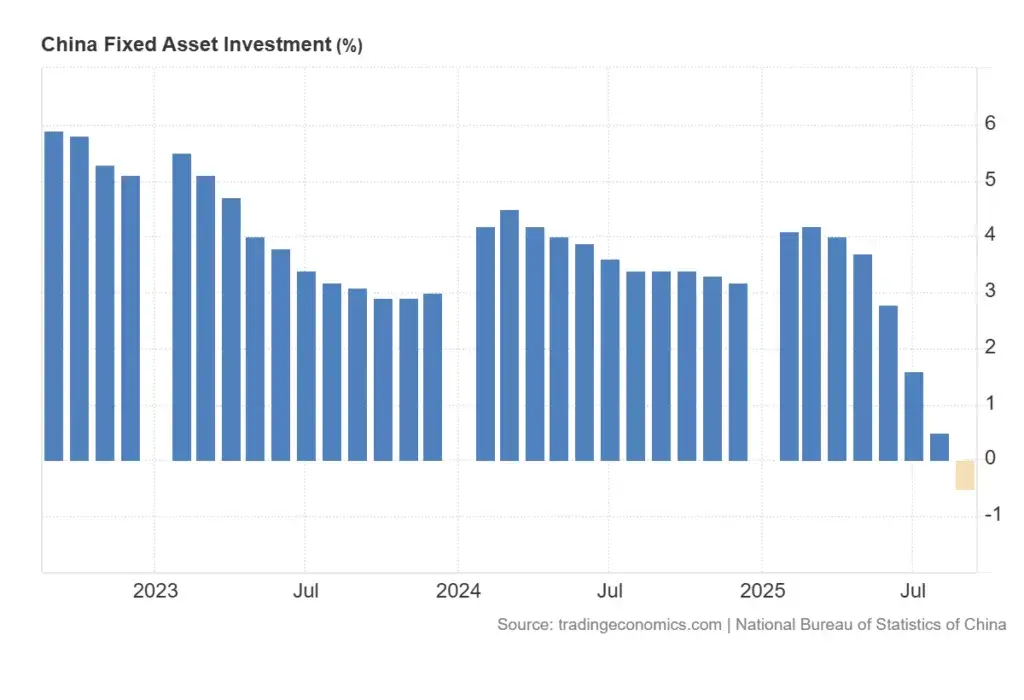
Fixed Asset Investment turned negative for the first time in the available data, recording -0.5% growth year-to-date, which points to a significant pullback in capital expenditure. Consumer spending also showed signs of softening, with Retail Sales growth slowing to 3.0% year-on-year in September.
The data also reveals ongoing challenges in the real estate sector, with the House Price Index falling -2.2% in September from a year earlier. In response to these mixed conditions, the People’s Bank of China (PBoC) has maintained an accommodative monetary policy, keeping the 1-year and 5-year Loan Prime Rates (LPR) steady at 3.0% and 3.5% respectively, continuing its support for borrowing and economic activity.
Most Important Macro-Data Points This Week
| Data Point | Region | Date | Key Focus & Potential Market Impact | |
|---|---|---|---|---|
| GDP, Industrial Production & Retail Sales | China | Monday, Oct 20 | Focus: Health of the world’s second-largest economy. Impact: Strong data could boost global commodity currencies (AUD, NZD) and equities; weak data may trigger risk-off sentiment. | China Retail Sales |
| Consumer Price Index (CPI) | Canada | Tuesday, Oct 21 | Focus: Bank of Canada (BoC) inflation path. Impact: Higher-than-expected inflation could strengthen the CAD and put pressure on the BoC to maintain a hawkish stance. | Canada Inflation Rate |
| Consumer Price Index (CPI) | United Kingdom | Wednesday, Oct 22 | Focus: Bank of England (BoE) policy path. Impact: A high print may force the BoE to keep rates higher for longer, supporting the British Pound (GBP). | United Kingdom Inflation Rate |
| Consumer Price Index (CPI) | United States | Friday, Oct 24 | Focus: The week’s highlight; signal for Fed policy. Impact: A soft reading could bolster bonds and risk assets while weakening the USD; a strong figure may revive hawkish fears, unsettling markets. | United States Inflation Rate |
- The Coordinated Campaigns of Disinformation Against the European Union and the ECHR are a Legal and Security Threat
 The most important evidence is the University of Oxford Bonavero Institute’s 2025 report, The European Convention on Human Rights and Immigration Control in the UK, which examined 379 UK media reports mentioning the ECHR in the first half of 2025. It found that around 75% of all ECHR-related coverage centred on immigration control — particularly… Read more: The Coordinated Campaigns of Disinformation Against the European Union and the ECHR are a Legal and Security Threat
- The Case for Recognising the UK Grooming-Gang Scandals as a Crime Against Humanity: A Full Legal and Consequentialist ArgumentThe Jay Report (2014) found that an estimated 1,400 children were sexually exploited in Rotherham alone between 1997 and 2013: a sixteen-year span, in a single town of roughly 260,000 people. The Telford Independent Inquiry (2022) found over 1,000 children exploited across several decades in a town roughly the same size. Separate convictions followed in… Read more: The Case for Recognising the UK Grooming-Gang Scandals as a Crime Against Humanity: A Full Legal and Consequentialist Argument
- Italy’s Human Rights Crisis: How State Violence, Far-Right Militias, and Neo-Fascist ‘Remigration’ Extremists Are Threatening DemocracyThis OSINT report establishes reasonable grounds to conclude that the activities of the organizations identified herein violate the threshold of the Italian constitutional framework prohibiting the reorganization of the Fascist Party and the instigation of racial hatred. The documented convergence of organizations historically associated with neo-fascist ideology; the systematic use of fascist symbolism, slogans, and… Read more: Italy’s Human Rights Crisis: How State Violence, Far-Right Militias, and Neo-Fascist ‘Remigration’ Extremists Are Threatening Democracy
- $296.0 Trillion Derivatives OTC Markets: Anatomy of Systemic Risk in America’s Banking Oligopoly
 The Office of the Comptroller of the Currency’s quarterly reports on bank trading and derivatives activities for the fourth quarter of 2025 and the first quarter of 2026 reveal a financial system that has transcended traditional banking to become something far more dangerous and far less understood. The numbers alone demand attention: total derivative notional… Read more: $296.0 Trillion Derivatives OTC Markets: Anatomy of Systemic Risk in America’s Banking Oligopoly
- THE GREAT FINANCIAL RACKET AND GLOBAL FRAUD: History of Markets from Commodity Exchanges to Systemic Fraud
 The story of financial markets begins not on Wall Street, but in the muddy fields of medieval Europe. Long before the Dutch East India Company issued the world’s first shares in 1602, merchants gathered at seasonal fairs—Champagne, Lyon, Antwerp—to exchange commodities, settle debts, and negotiate futures contracts. These were not sophisticated operations; they were practical… Read more: THE GREAT FINANCIAL RACKET AND GLOBAL FRAUD: History of Markets from Commodity Exchanges to Systemic Fraud