
The overall tone in Asian markets this morning is shaped by slower Japanese wage growth and weakening corporate sentiment, juxtaposed with supportive current account figures. Yen weakness is driving USD/JPY and affecting yen crosses like AUD/JPY. Australian housing softness and Indonesian consumer caution contribute to a nuanced regional outlook. Investors will monitor upcoming Japanese inflation and BoJ communications for further clues on policy direction. European markets and the US market open will likely take cues from these developments alongside their respective macro releases.
Japan Economic Data
- Average Cash Earnings YoY rose 1.5% in August, slowing sharply from 3.4% in July and missing consensus forecasts of 2.6%. This slowdown highlights weakening wage growth, a critical factor dampening household spending power. Real wages, already under pressure from persistent inflation above the Bank of Japan’s (BoJ) 2% target, continue to decline, signalling potential softness in domestic demand.
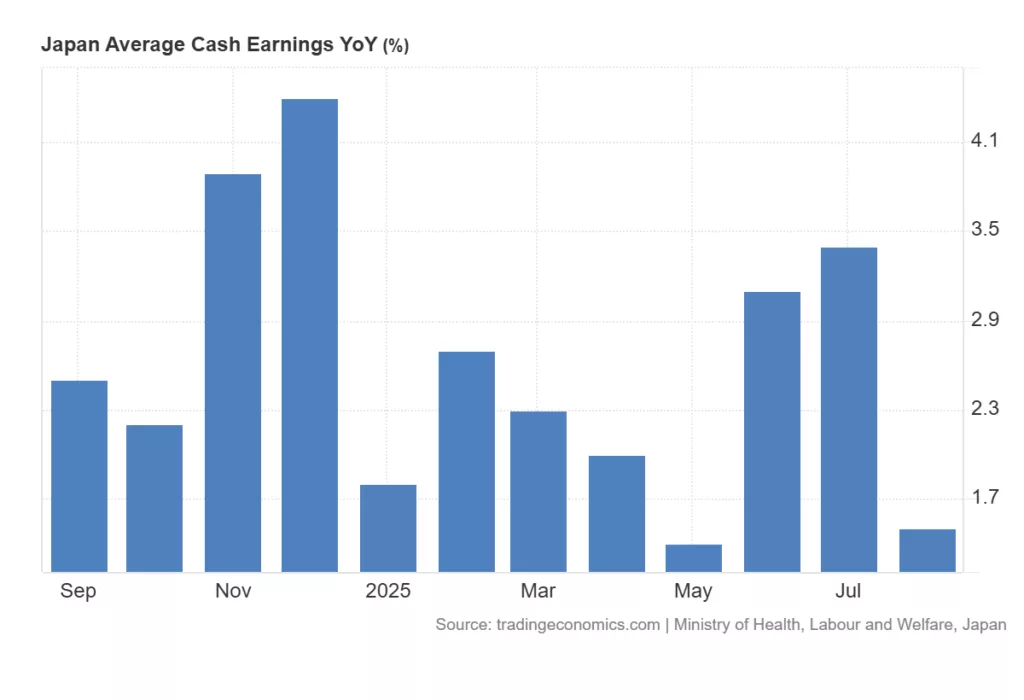
- Overtime Pay YoY also slowed to 1.3%, down from 3.0% previously, further reflecting moderation in labour compensation beyond base wages.
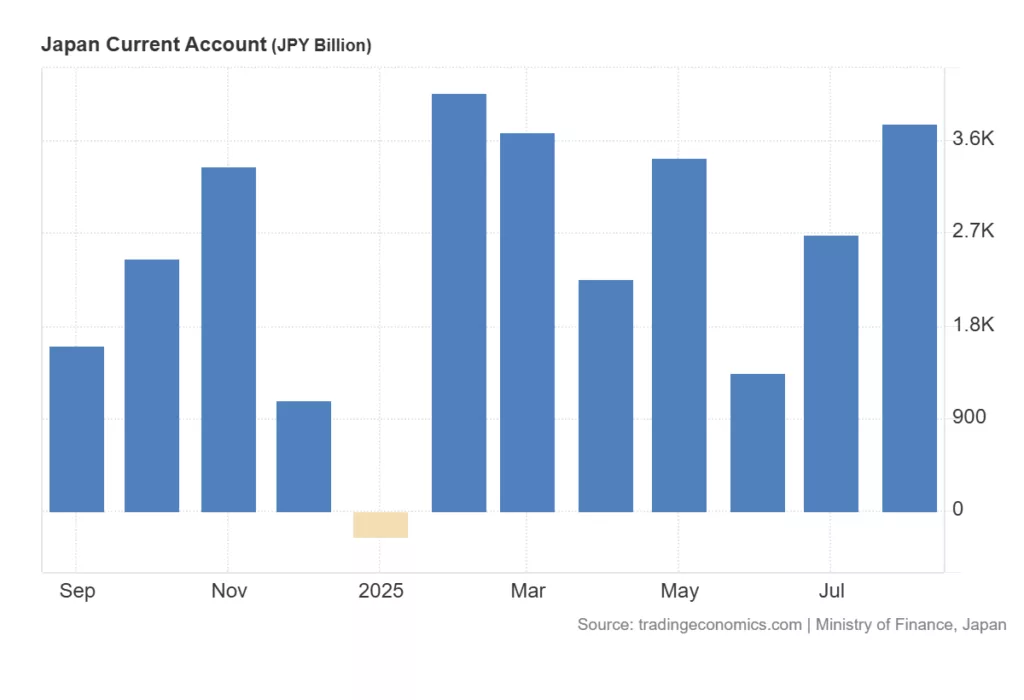
- Current Account surplus stood at ¥3,776 billion, well above forecasts and the previous month’s ¥2,684 billion, providing some support for the yen amid global uncertainty.
- The Reuters Tankan Index declined sharply to 8 in October from 13 in September, and below the expected 15, suggesting weakening business sentiment among Japanese companies.
- The Eco Watchers Survey, both current conditions (47.1) and outlook (48.5,) modestly beat expectations, indicating some resilience in consumer confidence despite other softness.
Australia Economic Data
- Building Permits MoM for August declined by 6.0%, an improvement over July’s -10%, but still pointing to a slowing residential construction sector.
- Private House Approvals MoM fell by 2.6%, signalling ongoing weakness in the housing market.
Indonesia Economic Data
Consumer Confidence in September registered 115.0, below the expected 120, suggesting cautious sentiment among Indonesian consumers.
FX MOVERS
The FX pairs that react fastest to overnight economic data tend to be those involving economies with active trading sessions overnight and high liquidity. According to recent sources, the key pairs with the fastest reactions are:
- USD/JPY: Highly liquid and active during the Asian session; sensitive to Japanese and US economic data.
- AUD/JPY and AUD/USD: Reflect economic activity in Australia and Japan, with commodity price influences; often volatile overnight.
- NZD/JPY and NZD/USD: Influenced by New Zealand economic data and global risk sentiment.
- EUR/JPY and GBP/JPY: Cross pairs involving major Asian and European economies, reacting to both regions’ economic news.
- AUD/NZD: Often moves with regional economic reports from Australia and New Zealand and offers stable yet responsive movements overnight.
These pairs show increased volatility and liquidity during the Asian and early European sessions, making them most responsive to overnight economic releases and geopolitical developments.
- UNITED STATES GOVERNMENT VIOLATIONS OF HABEAS CORPUS ARE A VIOLATION OF ARTICLE 3 OF THE NATO TREATY AND A THREAT TO INTERNATIONAL LAW
 THE UNITED STATES OF AMERICA WILL BE OFFICIALLY DEFINED: ROGUE STATE IN THE FORM OF ETHNO-NATIONALIST, NAZIST, WHITE SUPREMATIST, GENOCIDAL TOTALITARIAN DICTATORSHIP. The UNITED STATES Government Has Been Acting Unlawfully In violation of Constitutional Civil Rights And International Law Treaties, not fulfilling its obligations to the Principles Of Article 3 Stated In The NATO TREATY… Read more: UNITED STATES GOVERNMENT VIOLATIONS OF HABEAS CORPUS ARE A VIOLATION OF ARTICLE 3 OF THE NATO TREATY AND A THREAT TO INTERNATIONAL LAW
 - The Necessity of a United Nations HQ Relocation to the Hague with a Permanent Nuremberg Tribunal.The Impunity Crisis of Rogue Governments
 The world witnesses today an unprecedented crisis of accountability in international law. As the genocide in Gaza unfolds before global eyes, as war crimes multiply across Ukraine, Myanmar, and countless other conflicts, the United Nations stands paralysed, not by lack of legal framework, but by institutional capture that protects the very criminals it should prosecute.… Read more: The Necessity of a United Nations HQ Relocation to the Hague with a Permanent Nuremberg Tribunal.The Impunity Crisis of Rogue Governments