
The United Kingdom is experiencing the most severe and sustained wave of antisemitism in its post-war history. What began as a statistical surge in hate incidents following the Hamas terror attack of 7 October 2023 has since metastasised into a pattern of coordinated, lethal, politically-charged violence targeting Jewish people and institutions with a frequency and intensity that is, in the judgment of this report, without precedent in modern British history. On 27 May 2026, fire broke out at Kosher Kingdom, the largest kosher supermarket in London’s Golders Green district — the historic heart of British Jewish communal life. This follows directly upon: the stabbing of two Jewish men on Golders Green Road on 29 April 2026; the arson of four Hatzola Jewish ambulances on 23 March 2026, claimed by an Iran-linked Islamist terror group; and a series of arson attacks on synagogues and Jewish community institutions in the months preceding. The October 2025 Yom Kippur car-ramming and stabbing at Heaton Park Hebrew Congregation synagogue in Manchester, which killed two worshippers, marked the first fatal antisemitic terror attack ever recorded on British soil by the Community Security Trust (CST) since it began monitoring in 1984. This report situates these attacks within a broader structural framework encompassing: the normalisation of anti-Jewish rhetoric across the political spectrum; the erosion of the UK’s human rights legislative architecture through the Nationality and Borders Act 2022 and Illegal Migration Act 2023, which UN bodies have identified as incompatible with international law; the emboldening of extremist political actors; foreign state interference (particularly Iranian); and an exodus psychology now measurable among British Jews, with aliyah (emigration to Israel) reaching its highest point in over 40 years.
Data Findings
3,700 antisemitic incidents in UK in 2025 — second-highest on record (CST). Average of 308 per month, double the pre-October 2023 rate. First fatal antisemitic terror attack in recorded British history (Manchester, October 2025). Coordinated arson campaign in Golders Green (March–May 2026) linked to Iran-backed terror. 742 British Jews emigrated to Israel in 2025 — highest in 40+ years. One in five Britons holds antisemitic views (Daily Telegraph, September 2025). UN bodies formally condemned UK immigration legislation as violating international human rights law.
THE 2026 GOLDERS GREEN CRISIS: A CHRONOLOGY OF TERROR
Golders Green in the London Borough of Barnet is home to the United Kingdom’s largest and most visible Jewish community. What has unfolded there between March and May 2026 constitutes a sustained, coordinated campaign against Jewish life that is unique in post-war British experience.
The Hatzola Ambulance Arson — 23 March 2026
In the early hours of 23 March 2026, at approximately 1:40 a.m. GMT, three hooded individuals poured accelerant over four Hatzola ambulances parked at Highfield Road, adjacent to the Machzike Hadath Orthodox synagogue, and set them ablaze. Three vehicles were destroyed outright; a fourth was severely damaged. Exploding oxygen cylinders shattered windows in an adjacent residential block. There were no casualties. Metropolitan Police Counter Terrorism Command immediately assumed investigative responsibility. A video circulated online in which a group calling itself Harakat Ashab al-Yamin al-Islamiyya — a proscribed front organisation with documented links to Iran’s Islamic Revolutionary Guard Corps (IRGC), previously responsible for attacks on Jewish targets in Belgium and the Netherlands — claimed responsibility. Police arrested five male suspects; three were charged with arson with intent to endanger life. Prime Minister Keir Starmer condemned the attack as “a deeply shocking antisemitic arson attack.”
Synagogue Arson Campaign — March–April 2026
Following the Hatzola arson, a series of further arson attacks was carried out against synagogues and Jewish communal buildings across London and its environs. A man was separately charged with the arson of a former synagogue in another part of London. The CST documented multiple attacks on Jewish institutions during this period, reflecting what community leaders described as an intensifying campaign of communal intimidation.
The Golders Green Road Stabbing — 29 April 2026
On 29 April 2026, a 45-year-old Somali national ran along Golders Green Road attempting to stab Jewish passers-by. Two Jewish men were wounded. The attacker was apprehended and charged with attempted murder. The Crown Prosecution Service subsequently charged the perpetrator with two counts of attempted murder. Israeli President Isaac Herzog expressed being “horrified by yet another violent attack on Jews in broad daylight on the streets of London.” The following day, Prime Minister Starmer visited the scene and was confronted by protesters carrying signs reading “Keir Starmer, Jew Harmer.” The British government formally declared antisemitism a national emergency. The UK’s national terrorism threat level was raised to Severe.
Israeli Student Attack — May 2026
Earlier in May 2026, a 22-year-old Israeli man was attacked in Golders Green in a separate antisemitic incident, adding to the pattern of targeted violence against identifiably Jewish individuals in the neighbourhood.
Kosher Kingdom Fire — 27 May 2026
At approximately 6:47 a.m. on 27 May 2026, the London Fire Brigade received 56 simultaneous emergency calls reporting a fire at Kosher Kingdom, the largest kosher supermarket on Golders Green Road. Ten fire engines and 70 firefighters from Finchley, Willesden, and West Hampstead attended. The fire affected the ground floor shop and rear storage area of a three-storey building. Significant smoke forced road closures and evacuations. Metropolitan Police officers assisted at the scene. The cause of the fire remained under investigation at the time of this report’s preparation. The proximity of this fire to the site of the April stabbing, and its occurrence within a two-month arc of coordinated attacks on Jewish targets in the same locality, renders any purely coincidental explanation implausible without forensic evidence to the contrary.
THE STATISTICAL DIMENSION: ANTISEMITISM AT RECORD LEVELS ACROSS THE UK
The violence in Golders Green is not isolated but represents the acute expression of a sustained structural deterioration in the safety and security of Jewish life in the United Kingdom. The data compiled by the Community Security Trust constitutes the most authoritative longitudinal dataset on antisemitic incidents in British history.
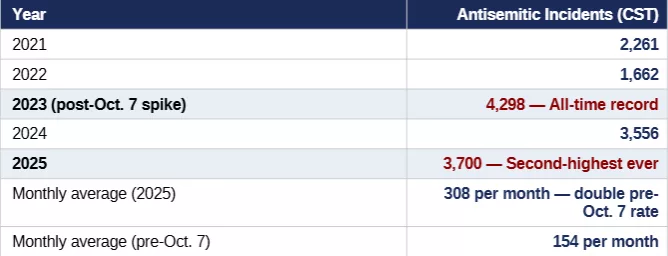
For the first time ever, the CST recorded more than 200 antisemitic incidents in every single calendar month throughout 2025. The CST Chief Executive Mark Gardner stated the findings reflected “the depths of extremism faced by Jews and all our British society.” Prior to October 2023, monthly totals exceeding 200 had only been recorded on five occasions in CST’s entire history, each coinciding with periods of active Israeli military engagement. The sustained elevation of incident levels through 2024 and 2025 — persisting through ceasefire periods — indicates a structural rather than episodic shift in the character of antisemitism in Britain.
The Manchester Yom Kippur Attack: A Historical Watershed
The most severe single event in the CST’s 41-year monitoring history occurred on 2 October 2025, the holiest day of the Jewish calendar. Jihad al-Shamie, a 35-year-old British citizen of Syrian descent, drove a vehicle into pedestrians at the Heaton Park Hebrew Congregation synagogue in Crumpsall, north Manchester, before exiting the vehicle and attempting to stab worshippers. Adrian Daulby (53) and Melvin Cravitz (66) died as a result of the attack. Three others were seriously injured, one of whom was struck by police gunfire during the response. Al-Shamie was shot dead by armed officers. He was found wearing a vest that had the appearance of a suicide device. Seven individuals were subsequently arrested in connection with the attack, with one charged with preparation and dissemination of terrorist publications. The Islamic State was identified as the operative ideology behind the attack.
Particularly alarming data published in The Daily Telegraph in September 2025 revealed that one in five British citizens holds antisemitic views. Further, approximately 45% of the British population believes that Israel treats Palestinians as the Nazis treated Jews — a form of Holocaust inversion that both trivialises genocide and creates a cultural permission structure for anti-Jewish violence. These figures represent a qualitative shift in the social normalisation of antisemitic attitudes.
POLITICAL EXTREMISM, RHETORIC, AND THE EROSION OF CIVIC NORMS
The violence against British Jews does not occur in a political vacuum. It is produced and sustained by a multi-directional political environment in which antisemitism has been progressively normalised across the ideological spectrum, from Islamist extremism linked to foreign state actors, through the hard-left’s treatment of Zionism as an acceptable target for vilification, to the far-right’s historic and present engagement with anti-Jewish conspiracy theories.
The Historical Extremist Far Right Threat to Jews
Reform UK, which polled as the leading party in national opinion polling through much of 2025–2026 and achieved significant gains in local elections in May 2026 (securing 1,454 council seats and control of 14 councils), has faced systematic criticism for failures in candidate vetting. In Essex, Reform candidate Stuart Prior won a council seat despite prior social media posts praising the rape of ethnic minority women, using racist epithets, and referencing “the master race.” A separate Reform candidate, Caspar Thomas, shared antisemitic and anti-Muslim content while campaigning for far-right organisation Restore Britain. A candidate in the same election events was found to have posted conspiracy theory on Facebook that “the Holocaust is a hoax.”
Political figures across the spectrum have failed to provide the unequivocal, ideologically precise condemnation that the situation demands. Critics, including senior commentators at The Spectator, have noted a persistent reluctance within the Starmer government to name Islamist ideology as the primary driver of the current terror wave, with ministers preferring vague references to “extremists” that decline to specify which extremist belief system is responsible. This rhetorical evasion, however understandable in terms of domestic community relations management, constitutes a failure of civic leadership that emboldens perpetrators and leaves the Jewish community without the explicit state solidarity it requires.
THE LEGISLATIVE FRAMEWORK: HUMAN RIGHTS EROSION AND ITS CONSEQUENCES
The making of a national-social tinderbox of extremist ethno-nationalists in Britain akin to the Third Reich National-Socialist Regime has been sparked since the Brexit Referendum campaign and with all the consequences that Brexit has brought upon ordinary people in the UK and across Europe, so that the heightened extremist ethno-nationalist rethoric and Anti-Semitic , Xenophobic troopes, have brought to the systematic erosion of civil and human rights, the curtailing of freedom of movement, the raising of barriers and borders rethoric and eventually to kinetic military conflict in Europe and across the Globe. In these circumstances, the crisis facing British Jews must be understood alongside a parallel legislative crisis: the systematic dismantling of the UK’s human rights protections through legislation that UN treaty bodies, the UN High Commissioner for Human Rights, the UN High Commissioner for Refugees, and dozens of civil society organisations have identified as incompatible with international law.
The Nationality and Borders Act 2022
The Nationality and Borders Act 2022, introduced by then-Home Secretary Priti Patel, enacted several provisions of profound human rights concern. The Act criminalises irregular entry to the United Kingdom as an asylum route, introduces offshore processing, expands powers to strip citizenship from dual nationals, and authorises maritime pushbacks. It was roundly condemned by the UN Refugee Agency (UNHCR), multiple UN Special Rapporteurs, and more than 200 domestic civil society organisations at the time of its passage. The relevant analytical linkage to the antisemitism crisis lies in the broader political signal these measures send: that the UK government is prepared to place domestic political expediency above binding international obligations. When a state demonstrates that human rights instruments are negotiable, it creates a cultural precedent that resonates across all domains of minority protection.
The Illegal Migration Act 2023
The Illegal Migration Act 2023, introduced by Home Secretary Suella Braverman, represents an even more radical departure from international legal norms. Its provisions, as assessed by the UN Office of the High Commissioner for Human Rights (OHCHR), include:
•Extinguishing access to asylum for anyone arriving “irregularly,” regardless of the merits of their protection claim, thereby creating what the UNHCR described as a de facto “asylum ban in the UK.”
•Creating sweeping new detention powers with minimal judicial oversight, including automatic detention for up to 28 days without access to immigration bail or judicial review.
•Authorising ministers to disregard interim measures issued by the European Court of Human Rights — a provision that directly undermines the enforceability of the ECHR system. (It was an ECHR Rule 39 interim measure that prevented the first Rwanda deportation flight from departing in June 2022.)
•Barring persons subject to removal from re-entering the UK or applying for citizenship in the future, with no individual risk assessment requirement.
UN experts formally urged the UK government to halt implementation of the Act, stating: “Any deportation policy is in direct breach of the UK’s commitments and obligations under international human rights and refugee law if it fails to provide for due process safeguards, individualised risk assessments, asylum procedures and adequate protection measures.” The OHCHR specifically noted that the Act creates conditions analogous to enforced disappearance for certain categories of persons, given the absence of procedural transparency or accountability in removal operations.
The Anti-Semitic tropes of Mass-Deportation are an incitement to commit Crimes Against Humanity, while the UNHCR and the High Commissioner for Human Rights (OHCHR) set in the treaties ample provisions to sanction the crime of Enforced Disappearance, where The UN Declaration on the Protection of All Persons from Enforced Disappearance (1992) and the Rome Statute (Article 7) define enforced disappearance as including state-organised removal of persons from legal protection frameworks with intent to deprive them of legal recourse. Multiple UN rapporteurs have identified elements of the UK’s deportation regime, particularly its provisions authorising removal in the face of live ECHR interim measures, as engaging these prohibitions.
The Border Security, Asylum and Immigration Act 2025: Constitutional Pathologies and the Risk of Executive Unaccountability
The Act must be understood not in isolation but as the third layer of a legislative trilogy: the Nationality and Borders Act 2022, the Illegal Migration Act 2023, and now the BSAIA 2025. Each successive Act was presented as a reform or corrective to the previous one; each in practice retained or expanded the core constitutional pathologies while adding new ones. The result is a compounding structure of executive discretion, eroded judicial oversight, and hollowed-out procedural rights. The fundamental constitutional danger is best framed through Lord Hailsham’s warning, which remains cited by constitutional scholars today: it is well over half a century since Lord Hailsham warned of the dangers of an “elective dictatorship,” and it would be naive in the extreme to assume that such dangers have receded. In the absence of a codified constitution that defines and limits legislative and executive power, the ECHR-HRA model is an important — even if imperfect — safeguard against such dangers. Moving away from that model without replacing it with equivalent safeguards would be constitutionally catastrophic. Publiclawforeveryone
The UK, uniquely among major liberal democracies, has no codified constitution. Its protections against executive overreach rest on three pillars: parliamentary sovereignty, common law rights, and the Human Rights Act 1998 (incorporating the ECHR). The legislative trajectory since 2022 has systematically weakened all three.
Detention Without Judicial Oversight: The Section 12 Problem
The single most constitutionally dangerous provision carried forward into the 2025 Act is Section 12 of the Illegal Migration Act 2023, which the BSAIA 2025 explicitly retained rather than repealing. Section 12 allows the Home Secretary to detain individuals “for such period as, in the opinion of the Home Secretary, is reasonably necessary” even if no immediate removal or decision is possible. This vague and sweeping power effectively permits indefinite detention based on executive discretion alone. It risks breaching Article 5 ECHR, which safeguards the right to liberty and security, and displaces judicial oversight with unfettered executive authority. DPG Law
The constitutional gravity of this cannot be overstated. In ordinary criminal proceedings, no person may be detained without judicial authority. The decision to imprison is made by a court. In immigration detention, by contrast, the decision to detain is administrative and made by an immigration official or the Home Secretary. Unlike in criminal proceedings, decisions to detain are not made by a judge. There is no fixed limit on the length of time someone can be detained — other than for children and pregnant women — and the period of detention is not predetermined by the Home Office, meaning that detention can be indefinite. Parliament
This is a structural breach of the separation of powers in its most elementary form: the executive imprisons; the judiciary is sidelined. Article 5 ECHR permits detention “with a view to deportation” — but this new power arguably exceeds what Article 5 permits, because detention continues even where no immediate removal or decision is possible. Detention Action The Law Society — the professional body for solicitors in England and Wales, which cannot be characterised as a radical organisation — made an extraordinary submission to Parliament: Section 12 of the Illegal Migration Act grants wide powers of detention to the Secretary of State and removes the oversight of the courts over how long a person can be detained. The Law Society urged full repeal. The government retained it. Parliament There is also a specifically alarming retrospectivity problem. Clause 41 of the Bill applies retrospectively. As a general principle of the rule of law, laws should not be applied retrospectively unless there is a strong justification. No justification was provided. Where retrospective law negatively impacts fundamental rights — as expanding detention powers does — the presumption against retrospectivity should be taken even more seriously. The government was asked to detail the lawfulness of the Secretary of State being able to detain a person when detention would not have been in accordance with a procedure prescribed by law at the time, ultimately undermining the rule of law. Parliament
Home Secretary Power to Override Courts: The Article 6 Crisis
This is perhaps the most constitutionally radical provision in the 2025 legislative package. Amendments introduced new powers for the Home Secretary to override decisions by the courts on individual asylum cases, which could potentially undermine the right to a fair trial (Article 6 ECHR) and the separation of powers. DPG Law
This is extraordinary. The separation of powers — the doctrine that the executive, legislature, and judiciary operate as distinct and mutually checking institutions — is one of the foundational principles of the British constitution, even in its uncodified form. The executive overriding specific judicial determinations on individual cases is not a border-management measure; it is the structural definition of executive capture of the judicial function. Article 6 ECHR guarantees the right to a fair trial before an independent and impartial tribunal. An “independent” tribunal, by definition, is one whose decisions are not subject to override by the very executive whose conduct is being reviewed. When the Home Secretary can set aside a court’s ruling in an individual asylum case, the court is no longer independent in any meaningful constitutional sense — it becomes an advisory body whose conclusions the executive may accept or reject at political convenience. The implications extend far beyond immigration. If Parliament can grant the executive power to override court rulings in asylum cases, the constitutional principle permitting that extension of executive power is not limited to asylum cases. The precedent is dangerous precisely because of its generalisability.
Inadmissibility Without Individual Assessment: The Article 3 and Refugee Convention Problem
Section 59 of the Illegal Migration Act 2023, retained by the 2025 Act, renders asylum and human rights claims from nationals of certain countries automatically inadmissible, save for “exceptional circumstances.” Countries targeted include India, Albania, and Georgia, despite persistent reports of persecution, particularly against LGBTQI+ individuals. This indiscriminate approach potentially violates the fundamental requirement of individualised assessment, enshrined in domestic asylum law, the 1951 Refugee Convention, and Articles 3 and 8 of the ECHR. DPG Law. The principle of non-refoulement — the prohibition on returning a person to a country where they face a real risk of torture, persecution, or inhuman treatment — is the foundational norm of international refugee law. It is absolute: it admits no derogation, not even in national emergencies. The Act’s blanket inadmissibility provisions, applied by nationality rather than by individual risk assessment, are structurally incompatible with non-refoulement because they eliminate the assessment process by which that risk is established.
The OHCHR and UNHCR jointly warned that the legislation bars people from presenting refugee protection or other human rights claims, no matter how compelling their circumstances, and requires their removal to another country with no guarantee that they will necessarily be able to access protection there. OHCHR. This is not a legal technicality. It means that a gay man from Georgia facing persecution, or a political dissident from Albania with a credible threat to their life, may be removed to their country of persecution without any court ever examining their case — because the Act deems their nationality sufficient ground for inadmissibility. This is collective punishment by passport.
Offshore Detention: Replicating the Rwanda Logic Without the Rwanda Label
The Act includes provisions permitting detention in offshore facilities with limited judicial review access. The constitutional significance of this is profound. The Safety of Rwanda Act 2024 — which was repealed by the 2025 Act — was condemned by the Law Society for having “set a dangerous precedent by legislating to overturn a finding by UK courts that Rwanda is an unsafe country, with serious implications for the rule of law and human rights.” DPG Law. The offshore detention provisions in the 2025 Act replicate the structural logic of the Rwanda scheme — placing detained persons outside the geographic jurisdiction where judicial oversight is most practically effective — without the political visibility that the Rwanda scheme attracted. Detention in offshore facilities with “limited judicial review access” is, in plain constitutional terms, a mechanism for insulating executive action from judicial scrutiny by engineering physical distance from the courts.
Data Sharing and Surveillance Powers Without Adequate Oversight
The 2025 Act significantly expands data-sharing powers across enforcement bodies, allowing access to substantially more personal information to support immigration enforcement. The new Act also introduces more extensive powers of search, seize and retain relating to electronic devices, extending their application beyond persons liable to detention under the Illegal Migration Act. Free Movement. These expanded surveillance and data powers, combined with weakened judicial oversight of detention decisions, create a particularly dangerous combination: the executive can gather extensive personal information about individuals, make detention decisions based on that information, and face limited judicial challenge to either the information-gathering or the detention itself. In any other domain of public law, such a combination would be recognised as authoritarian in character.
The ECHR Withdrawal Trajectory: The Broader Political Danger
The 2025 Act operates within a broader political trajectory that is explicitly hostile to the judicial enforcement of human rights. In October 2025, Reform UK leader Nigel Farage proposed in the Commons a bill to leave the ECHR. The Conservative Party, now in opposition, has made ECHR withdrawal explicit policy: the Conservative Party leader stated at the October 2025 conference: “We must leave the ECHR and repeal the Human Rights Act. The next Conservative manifesto will contain our commitment to leave. Leaving the Convention is a necessary step.” Justice Secretary Shabana Mahmood’s speech at the Council of Europe set out the Labour government’s own view that both the Human Rights Act 1998 and the ECHR itself need to be reformed. Even the party currently in government, which has formally maintained ECHR membership, is signalling appetite for reform that would weaken the courts’ ability to enforce rights against executive action. Publiclawforeveryone
The constitutional scholar’s analysis is stark: the notion that ridding the UK constitution of the ECHR-HRA model would restore some “pure” version of parliamentary sovereignty entailing absolute legislative freedom unhindered by political constraints is misconceived. It was well over half a century since Lord Hailsham warned of the dangers of an “elective dictatorship,” and it would be naive in the extreme to assume those dangers have receded. Publiclawforeveryone A Member of Parliament captured the logical endpoint in the ECHR withdrawal debate in Hansard: “If we do what Reform wants, the biggest cheers will come from the Kremlin, from Beijing, from Tehran, from Pyongyang, and from dictators…” UK Parliament
The Constitutional Synthesis: Why This Is Structurally Different
The cumulative constitutional danger of this legislative trajectory is qualitatively different from ordinary policy disagreement, for the following reasons: The uncodified constitution problem. Most liberal democracies have a codified constitution that explicitly enumerates and protects fundamental rights, and which courts can use to strike down incompatible legislation. The UK does not. Parliament can make or unmake any law it wants. The executive cannot unilaterally repeal domestic legislation without Parliamentary authority — but Parliament itself faces no formal constitutional constraint on what it can legislate. This means the entire human rights architecture rests on the political commitment of successive Parliaments to maintain it. When that political commitment weakens — as it is visibly doing — there is no constitutional backstop. Constitution Society
The ouster clause trajectory. Parliament’s growing disregard for constitutional fundamentals and the judiciary’s arguable incursions into legislative territory may have incited a silent constitutional crisis. In an age of misinformation and ongoing assault on the judiciary, we have reason to advocate for more, not less, candour in the judiciary, even if this entails revisiting the absoluteness of parliamentary sovereignty. UK Constitutional Law Association
The minority protection nexus. When a state’s legal architecture makes it easier to detain people without judicial oversight, removes individualised assessment from protection decisions, authorises executive override of court rulings, and creates offshore enforcement zones outside effective judicial reach — all while the principal political opposition campaigns on leaving the treaty that makes those measures challengeable — minority communities lose the legal infrastructure that protects them. The Jewish community’s situation, documented in the main report, is not unrelated to this trajectory: a state that treats the rule of law as instrumentally rather than intrinsically valuable cannot be relied upon to protect any minority when political incentives point the other way.
What Would Genuine Constitutionalism Require?
The contrast with a constitutionally sound framework is instructive. A system consistent with rule of law principles would require:
- Judicial authorisation before any detention beyond a brief initial period, not executive-administrative decision-making
- A statutory maximum detention period without judicial review, regardless of removal prospects
- Individual risk assessment for every asylum claim, regardless of nationality
- No executive power to override specific judicial rulings on individual cases
- Judicial review access not limited by geographic location of detention
- All surveillance and data collection subject to independent judicial authorisation
- A codified constitutional floor — or at minimum an entrenched Human Rights Act — that Parliament cannot remove by simple majority
None of these are radical propositions. They are the ordinary architecture of rule-of-law governance in Germany, France, Canada, or any ECHR signatory operating in good faith. The trajectory of UK immigration legislation since 2022 moves away from every one of them.
What it constitutes is the construction of the machinery that a future government with authoritarian intentions could deploy: indefinite detention without courts, removal without individual assessment, executive override of judicial decisions, and offshore enforcement beyond the reach of effective legal challenge. That machinery, once built into statute, is available to whoever holds executive power. The danger is not today’s government. It is that the institutional architecture being assembled is not government-specific and coule become permanent, and if not condemned headon, it could lead to biblical scale democratic crisis.
The Connection to Antisemitism: A Structural Analysis
The conjunction between the legislative erosion of human rights protections and the rise of anti-Jewish violence is not direct but structural and cultural. When governments publicly signal that international norms are negotiable and that minority protection is subordinate to majoritarian political preference, they create a permissive environment in which all forms of minority persecution are implicitly enabled. The Jewish community, as a numerically small, highly visible, and politically complex minority in the UK, is uniquely exposed to this structural vulnerability. Furthermore, the specific scapegoating dynamic that fuels antisemitism — the attribution of collective guilt to Jewish people for the actions of the Israeli state — has been amplified by political figures across the spectrum who have been unwilling or unable to distinguish between legitimate criticism of Israeli government policy and the targeting of Jewish individuals and institutions in the United Kingdom. This analytical failure at the level of political leadership constitutes a form of implicit enablement.
The Jewish community’s response to the current crisis reflects a rational calculus of risk in a deteriorating security environment. The data on emigration, community sentiment, and the extraordinary security architecture now surrounding Jewish institutions in the UK provides a sobering picture of a community under sustained existential pressure. According to the Institute for Jewish Policy Research (JPR), 742 British Jews emigrated to Israel in 2025 — the highest annual figure in over 40 years. Other Israeli government sources cite figures between 840 and 889 for the same period. While some analysts caution against describing this as an “exodus” — noting that emigration flows have historically been broadly balanced by Israeli immigration to the UK — the JPR itself acknowledges the deeper qualitative shift: As JPR Executive Director Dr. Jonathan Boyd stated in April 2026: “There is no Jewish exodus from the UK, at least not yet. But focusing on the numbers alone misses the deeper significance of what is happening. Since October 7, more British Jews are quietly reassessing what the future holds — not because they are rushing to leave, but because rising antisemitism, recurring shocks, and a growing sense of conditional security are prompting a rethinking of the future.” Some BBC Panorama programme in April 2026 reported that up to 25% of British Jews are seriously contemplating emigration. In May 2026, the annual Aliyah Day fair at StoneX Stadium in north London attracted a record number of attendees, with Israeli Aliyah and Integration Minister Ofir Sofer in attendance. The Israeli government has introduced a landmark tax incentive package explicitly targeted at British Jewish emigration, with the Ministry of Aliyah stating publicly: “Every one who makes Aliyah from now until the end of 2026 will benefit from this significant tax advantage. Come, we are waiting for you in Israel.”
The Aliyah Day fair at StoneX Stadium itself serves as an inadvertent emblem of the state of British Jewish life: attendees passed through airport-style securityì, CST volunteers, and Israeli security personnel merely to attend an information event about emigration. Jewish schools, synagogues, and communal institutions across the UK now operate behind levels of physical security — blast barriers, CCTV, security guards, counter-surveillance patrols — that are without parallel in any other sector of British civil society. Israeli activist Hen Mazzig, writing from London in March 2026, described British Jews as having reached an inflection point: they are no longer asking whether they will consider moving to Israel, but when. “I’m afraid that the Israeli government and the official bodies don’t realise how bad it is,” he wrote.
THE INTERNATIONAL LEGAL AND DIPLOMATIC FRAMEWORK
The crisis facing British Jews engages multiple interlocking frameworks of international law and diplomatic responsibility. This section addresses the applicable legal instruments and the obligations they impose on both the United Kingdom and the State of Israel.
The Convention on the Prevention and Punishment of the Crime of Genocide (1948)
While the threshold of genocide under international law is high and the current situation in the United Kingdom does not yet meet that threshold, the analytical framework of the Genocide Convention is relevant because it identifies the early warning indicators of mass atrocities: systematic dehumanisation, targeted violence, destruction of communal property, forced displacement, and the failure of state protection mechanisms. Several of these indicators are now observable in the UK context.
The International Convention on the Elimination of All Forms of Racial Discrimination (ICERD)
The UK is a State Party to ICERD, which requires it to prohibit and eliminate racial discrimination, including antisemitism, in all its forms. The Committee on the Elimination of Racial Discrimination (CERD) has previously expressed concern about the adequacy of UK measures to combat antisemitism. The current wave of violence, combined with the documented normalisation of anti-Jewish rhetoric in political discourse, raises questions about UK compliance with its ICERD obligations.
As noted above, multiple UN mechanisms have identified elements of the UK’s deportation and detention legislation as engaging prohibitions on enforced disappearance. The Rome Statute’s definition of enforced disappearance as a crime against humanity (Article 7(1)(i)) encompasses state-organised removal of persons with intent to place them outside the protection of the law for extended periods. While the UK regime is not identical to the paradigm case, the structural similarities — particularly the authority to override ECHR interim measures — are sufficiently proximate to warrant independent investigation.
Israel’s Obligations Under the Law of Return
The State of Israel has a legal and moral obligation under its foundational legislation — the Law of Return (1950) — to receive Jewish immigrants from any country. In the current context, where British Jews face a credible and escalating pattern of violence and where state protection mechanisms are demonstrably strained, this obligation carries heightened urgency. The Israeli government has already signalled its awareness of this responsibility through the deployment of the Aliyah and Integration Minister to London, the introduction of tax incentive packages for British olim, and public statements of solidarity.
•The Israeli government should formally prepare operational capacity for the reception and integration of British Jews who choose to exercise their right of return in response to deteriorating security conditions. This is not an alarmist measure but a prudent contingency preparation consistent with Israel’s foundational raison d’être.
•The Israeli Ministry of Aliyah and Integration should maintain its intensified engagement with the British Jewish community, including the deployment of dedicated absorption counsellors at the Israeli Embassy in London.
•Israel should formally raise the pattern of state-sponsored antisemitic violence in the United Kingdom at the UN Human Rights Council and in bilateral diplomatic communications with UK counterparts, citing the IRGC connection to the Hatzola arson as evidence of foreign state interference.
•The Mossad and relevant intelligence-sharing mechanisms should be activated to share actionable intelligence with UK counter-terrorism authorities regarding IRGC-linked networks operating in London.