
When Moses ascended Mount Sinai to receive the Law, the Israelites, freshly liberated from Egyptian slavery, grew restless in his absence. Their demand for a visible god led Aaron to collect their gold and fashion a golden calf, declaring, “These are your gods, O Israel, who brought you up out of the land of Egypt” (Exodus 32:4). This was not merely an act of disobedience; it was a fundamental betrayal of the covenant before it had even been fully established. The calf represented more than a false deity; it was the embodiment of a deeper moral failure, the substitution of divine justice for a man-made idol of wealth and spectacle.
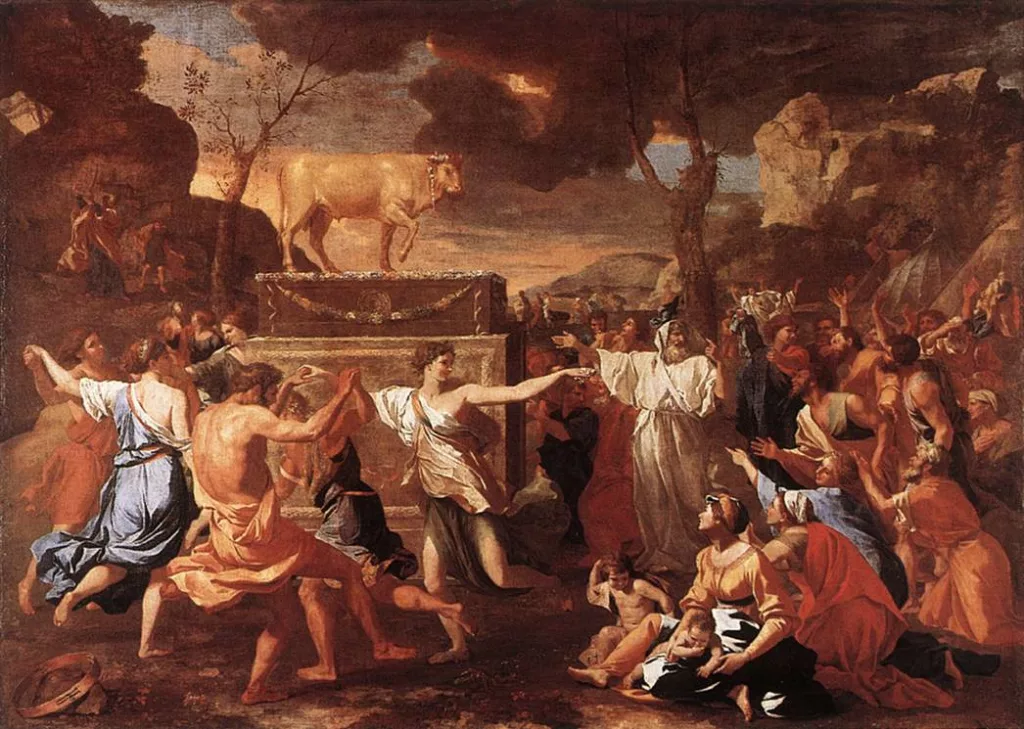
This betrayal reveals itself in the Israelites’ impatience with the invisible and their craving for the immediate. They had witnessed miracles, the plagues, the parting of the sea, the manna in the wilderness, yet when faced with Moses’s prolonged absence, they reverted to what felt familiar and controllable. The golden calf was not just a religious artefact but a psychological crutch, a tangible symbol that promised divine presence without demanding transformation of character or commitment to justice. Moses, upon witnessing the revelry, shattered the stone tablets in fury. This was not an impulsive act of rage but a profound symbolic gesture: the covenant had been broken by the people’s choice to worship their own creation rather than the unseen God who had delivered them. The tragedy of the golden calf was not just its existence, but the fact that the Israelites believed they could merge their worship of Yahweh with the veneration of a glittering statue. They wanted divinity on their own terms—tangible, controllable, and aligned with their immediate desires. The rabbinical tradition understands this moment as the paradigmatic example of avodah zarah, strange worship, not because the Israelites abandoned God entirely, but because they sought to domesticate the divine, to reduce the infinite to the finite, the moral to the material. The golden calf became a mirror reflecting their own desires rather than a window opening to transcendent truth.
Wall Street’s Golden Calf

Centuries later, in the shadow of modern finance, a different idol stands as a testament to the same human impulse. The Charging Bull of Wall Street, with its muscular bronze frame and aggressive posture, is more than a piece of public art—it is an unconscious monument to the deification of capital. Just as the golden calf was forged from the Israelites’ jewellery, the bull is the product of a financial system that extracts wealth from labour, debt, and speculation, concentrating it in the hands of a privileged few. The bull symbolises an unspoken creed: that markets are the ultimate arbiters of value, that economic growth is synonymous with moral progress, and that wealth is a sign of divine favour. Politicians and economists speak of “market forces” with the reverence once reserved for divine law, as if stock indices and quarterly profits were sacred texts. Traders and CEOs perform their rituals before the glowing screens of the New York Stock Exchange, much like the Israelites dancing around their molten idol. The parallel is unmistakable—both the calf and the bull represent the human tendency to worship what we can see, measure, and control, rather than the intangible principles of justice, equity, and humility. This modern idolatry manifests in several distinct ways. First, there is the doctrine of market fundamentalism, the belief that free markets are not merely useful tools for organising economic activity but are inherently righteous, self-correcting mechanisms that inevitably produce just outcomes. This theology of the market transforms economic inequality from a problem to be solved into a natural law to be accepted, even celebrated.


Second, there is the ritual of financialization, the process by which every aspect of human life is reduced to its monetary value. Education becomes a human capital investment, healthcare becomes a profit centre, housing becomes an asset class, and even personal relationships are subjected to cost-benefit analysis. The sacred dimensions of existence, love, beauty, justice, and community are flattened into quantifiable metrics and market opportunities. Third, there is the priesthood of technocratic expertise, Federal Reserve governors, investment bank analysts, and economic consultants who claim objective knowledge of market mysteries while serving the interests of wealth concentration. Like the ancient priests who claimed exclusive access to divine will, these modern oracles speak in specialised languages (derivatives, quantitative easing, algorithmic trading) that obscure their fundamentally political choices behind veils of mathematical sophistication.
The 2008 financial crisis revealed the extent to which the American economy had become a giant casino, with banks creating complex derivatives and mortgage-backed securities that served no productive purpose beyond generating fees and bonuses. When this house of cards collapsed, the same institutions that had socialised the risks were allowed to privatise the bailout profits. The message was clear: financial institutions had achieved a status beyond moral accountability, a kind of corporate divinity that placed them above the laws governing ordinary mortals.
The Military-Industrial Complex: Moloch in Modern Dress
If Wall Street represents the golden calf of financial idolatry, the military-industrial complex embodies what the ancient Canaanites called Moloch, the god who demanded child sacrifice. The United States spends more on military expenditures than the next ten nations combined, not for defensive purposes but to maintain a global empire that serves corporate interests while consuming the nation’s youth and treasure. The Cold War provided the theological justification for this permanent war economy, casting every international conflict in apocalyptic terms that justified unlimited military spending. The importation of Nazi scientists under Operation Paperclip after World War II brought not just rocket technology but a technocratic mindset that subordinated moral considerations to technological capability and strategic advantage. The fusion of corporate capitalism with militaristic nationalism created what President Eisenhower warned against in his farewell address: “the acquisition of unwarranted influence, whether sought or unsought, by the military-industrial complex.” This complex has become a self-perpetuating system where military contractors fund think tanks that advocate for military interventions that require military contractors’ services—a perfect closed loop of profitable violence.
The human cost of this idolatry is measured not only in foreign casualties but in the spiritual degradation of American society itself. A nation that spends trillions on weapons while its citizens lack healthcare, education, and infrastructure has chosen to worship Mars rather than seek justice. The ancient prophets would recognise this immediately as the worship of death over life.
The State of Israel and the New Idolatry
The modern state of Israel was born in 1948 as a refuge for a people decimated by genocide, envisioned as a society rooted in the prophetic ideals of justice and righteousness. Its founding declaration invoked “freedom, justice, and peace” as its guiding principles, echoing the Torah’s command to “pursue justice and only justice” (Deuteronomy 16:20). The early Zionist movement, despite its secular orientation, carried within it the messianic hope of creating a society that would embody the ethical teachings of Judaism in concrete political form.
Yet in recent decades, a dangerous ideological shift has taken hold. A coalition of far-right political factions, ultranationalist settlers, militarists, and wealthy foreign backers has increasingly dictated the nation’s trajectory. This coalition does not represent all Jews, nor even all Israelis, but its influence has been profound and corrosive to Israel’s founding ideals. Under this influence, Israel has embraced policies that prioritise territorial expansion over human dignity, military dominance over diplomatic resolution, and ideological purity over pluralism. The occupation of Palestinian territories, initially presented as a temporary security measure following the 1967 war, has become a permanent system of control that violates the basic principle that all human beings are created b’tselem Elohim, in the image of God.
The settler movement, funded largely by American evangelical organisations and wealthy donors, has created facts on the ground that make a just resolution increasingly difficult. These settlements represent a form of idolatrous attachment to land that confuses geographical control with spiritual fulfilment. The biblical promise of land was always conditional upon justice and righteousness; when these conditions are abandoned, the promise itself becomes corrupted. The state has become economically dependent on U.S. military aid, locking itself into a cycle of perpetual conflict that serves American strategic interests while compromising Israeli sovereignty. This dependence represents its own form of idolatry, the worship of military power and foreign patronage rather than reliance on moral authority and diplomatic wisdom.
The original vision of Israel as “a light unto the nations”, a society built on ethical imperatives that would demonstrate the possibility of justice in the modern world, has been overshadowed by a new kind of idolatry: the worship of land, power, and security at the expense of moral accountability. The prophetic tradition that gave birth to ethical monotheism is being sacrificed on the altar of nationalist ideology.
עֲשִׂיַּת אֱמֶת (asiyat emet) the truth, it’s in doing the truth
In Biblical Hebrew, the verb עָשָׂה (asah) literally means to do, to make, to accomplish, but it also carries a figurative sense: to bring into reality, to put into practice, and the word (אֱמֶת, emet) “truth” is not primarily an abstract proposition to be verified logically; it is something lived, enacted, and upheld. Also, the expression עֲשִׂיַּת אֱמֶת (asiyat emet) means “doing truth”, not merely knowing or speaking truth, but embodying it through concrete actions. Another related phrase, קִיּוּם הָאֱמֶת (kiyyum ha-emet), means “sustaining truth”, preserving, confirming, and making truth endure in the world. In many biblical passages, “doing” (asah) justice, mercy, or truth means making them real in the world through behavior, relationships, and social order In Jewish thought, truth is not static; it is realized and maintained through righteous deeds, aligning the moral and the practical so that truth exists not only as an idea but as a lived ethically, truth is relational, ethical, and existential. It is something that happens in the interplay between God, humanity, and the world, rather than something merely observed or asserted.
The Greek Concept: ἀλήθεια (aletheia) as Unconcealment
In ancient Greek thought, especially as understood by philosophers such as Parmenides, Plato, and later reinterpreted by Martin Heidegger, ἀλήθεια (aletheia) literally means unconcealment (from a = not, and lethe = forgetting, concealment). In Plato’s Allegory of the Cave, truth is the movement from shadow (illusion) into the sunlight of the Forms, a process of revealing what was always there but unseen. Truth is that which comes into the open, which emerges from hiddenness into the sphere of the knowable.
Peaceful coexesistence between people, the right to life and to self-determination of the Palestian people and the peaceful coexistence with the Jewish people of Israel is something that has to be done in any jesture of daily life, recognising the human being in front of your eyes as nothing else than your brother or your sister, it has to be done always in any jesture of daily life, for Peace among Humanity to be the truth, if we mean doing the truth עֲשִׂיַּת אֱמֶת (asiyat emet), in how we live among our brothers and sisters.
Peaceful coexesistence between people, the right to life and to self-determination of the Ukranian people and the peaceful coexistence with their Russian and Bielorussian neighbours, it’s something that has to be done in any jesture of daily life, recognising the human being in front of your eyes as nothing else than your brother or your sister fellow human being, it has to be done always in any jesture of daily life, for Peace among Humanity to be the truth, if we mean doing the truth עֲשִׂיַּת אֱמֶת (asiyat emet), in how we live among our brothers and sisters.
America’s Golden Veal: Democracy in the Age of Plutocracy
The United States, too, has undergone its own idolatrous transformation, perhaps more subtle but no less profound than Israel’s. Founded on principles of liberty and equality, the nation now operates under the shadow of what can only be described as a financial-military oligarchy that has captured the mechanisms of democratic governance. The 2008 financial crisis laid bare the truth about American priorities: banks deemed “too big to fail” were rescued with public funds while ordinary citizens lost homes, jobs, and life savings. The government’s response revealed the actual hierarchy of values in American society—financial institutions ranked above families, corporate profits above human welfare, systemic stability above justice. The concept of “too big to fail” represents a form of economic theology that grants certain institutions a kind of immortality unavailable to ordinary mortals. These institutions can socialise their risks while privatising their gains, confident that their size and interconnectedness provide them with divine protection from market forces that discipline smaller entities. The Supreme Court’s Citizens United decision completed the transformation of American democracy into what scholars call “plutocracy”, rule by the wealthy. By defining corporate spending as free speech and removing limits on political contributions, the Court created a system where democratic participation is essentially proportional to financial resources. Elections became auctions, with policy outcomes determined not by popular will but by corporate investment. The revolving door between Wall Street and Washington ensures that regulatory agencies are captured by the industries they supposedly oversee. Former Goldman Sachs executives populate Treasury departments regardless of which party holds power, creating a continuity of financial policy that serves elite interests while maintaining the fiction of democratic choice. This systemic corruption is justified through a sophisticated ideological apparatus that presents corporate interests as identical to national interests, market outcomes as natural laws, and wealth concentration as the inevitable result of merit-based competition. The American dream becomes a theological doctrine that blames victims of economic violence for their own suffering while celebrating predators as job creators and innovators.
Bible Prophets Tradition and Literature Teachings
The Hebrew prophets provide the clearest lens through which to understand these contemporary forms of idolatry. Isaiah denounced rulers who “justify the wicked for a bribe, and take away the rights of the ones who are in the right” (Isaiah 5:23). Jeremiah condemned those who “build their house by unrighteousness, and their upper rooms by injustice; who make their neighbors work for nothing, and do not give them their wages” (Jeremiah 22:13). Ezekiel declared God’s judgment on princes who “shed blood within you to get dishonest gain” (Ezekiel 22:27). Prophetic tradition understands that idolatry is never merely a religious error but always a social and political catastrophe. When societies worship false gods, they inevitably create systems of oppression that benefit the few at the expense of the many. The golden calf required the gold of the people; the charging bull requires their labour and debt; the military-industrial complex requires their children and taxes. Amos’s famous declaration, “Let justice roll down like waters and righteousness like a mighty stream” (Amos 5:24), was not a beautiful metaphor but a revolutionary demand for the restructuring of society according to divine principles rather than human power arrangements. The prophets understood that authentic worship of the true God requires the pursuit of justice for all people, especially the most vulnerable. Prophet Micah summarized the divine requirement in terms that remain radical today: “What does the Lord require of you but to do justice, and to love kindness, and to walk humbly with your God?” (Micah 6:8). This three-fold obligation justice, kindness, humility stands in stark contrast to the values promoted by contemporary idolatries: exploitation, selfishness, and arrogance.
The Ecological Dimension: Consumption rather than Creation
Modern idolatry has produced an ecological crisis that threatens the survival of human civilisation itself. The worship of economic growth as an ultimate good has created a system that treats the Earth as a mine to be exploited rather than a garden to be tended. Climate change represents the inevitable consequence of societies that mistake consumption for fulfilment and progress for destruction. The biblical creation narrative presents humans as stewards (shamers) of creation, responsible for its care and preservation. This stewardship model stands in direct opposition to the extractive capitalism that has created the current ecological emergency. The Earth is not a commodity to be consumed but a sacred trust to be protected for future generations. Corporate agriculture, driven by profit maximisation rather than ecological sustainability, has created vast monocultures that depend on chemical inputs and genetic manipulation. This system produces food that is technically edible but nutritionally depleted, while destroying the soil, water, and biodiversity that make genuine abundance possible. The fossil fuel industry, knowing for decades about the climate consequences of their products, chose to fund denial campaigns rather than transition to renewable energy. This represents a form of corporate sociopathy that places short-term profits above the long-term survival of human civilisation. The golden calf of fossil fuel addiction is consuming its worshippers.
Technology as Idol: The Digital Golden Calf and the Homo Digitalis
The digital revolution has created new forms of idolatry that are particularly seductive because they promise connection while delivering isolation, knowledge while providing information, and empowerment while enabling surveillance. Social media platforms have become the newest temples of worship, where people sacrifice their privacy, attention, and authentic relationships on the altar of digital validation. Surveillance capitalism practised by tech giants like Google, Facebook, and Amazon represents a new form of economic exploitation that commodifies human attention, emotion, and social connection. These platforms extract valuable data from users while providing services that are designed to be addictive rather than genuinely useful. Artificial intelligence is increasingly presented as a solution to problems created by previous technological solutions, creating a cycle of dependence on systems that operate beyond human comprehension or control. The promise of AI replacing human judgment in critical areas like healthcare, education, and criminal justice represents a dangerous form of technological idolatry that abandons moral responsibility to algorithmic decision-making.
The “metaverse” and similar virtual reality projects promise escape from physical reality into digital worlds controlled by corporations. This represents perhaps the ultimate form of idolatry, the worship of artificial experiences over authentic reality, synthetic relationships over genuine community, and corporate-designed virtual worlds over the natural world that sustains all life.
The Necessity of Authentic Human Ethics, which is not Pathetic Bigotry
The story of the golden calf does not end with destruction but with the possibility of renewal. Moses returned to Mount Sinai, received new tablets, and restored the covenant between God and Israel. The key insight is that idolatry can be overcome, but only through genuine repentance, teshuvah, which means not just regret but a fundamental turning away from false worship toward an authentic relationship with the divine and with other human beings.
Moving beyond nationalism and imperialism toward forms of global governance based on human rights, ecological sustainability, and peaceful conflict resolution. This requires dismantling the military-industrial complexes that profit from international tension and the natural environment and nature degradation.
The prophet Hosea condemned the northern kingdom of Israel for its idolatry, declaring, “They made a calf at Samaria; for from Israel it came; a craftsman made it; it is not God. The calf of Samaria shall be broken to pieces” (Hosea 8:5-6). His words were both a warning and a promise: no society can long endure when it substitutes true justice for the worship of power and wealth, but no idolatry is so powerful that it cannot be overcome by genuine repentance and covenant renewal.
Today, we face the same choice that confronted the Israelites in the wilderness. Will we continue to bow before the bull of unchecked capitalism, the idol of militarism, and the false prophets of nationalism? Or will we be able to see the shattered ethics in all public offices and private corporations, which have become nests of corruption and bribery.
The golden calf was destroyed, and the Israelites were forced to reckon with their betrayal. The charging bull of Wall Street, the military-industrial Moloch, and the digital idols of technological utopianism can likewise be dismantled, but only if we choose covenant over calf, justice over power, and the difficult path of moral transformation over the seductive simplicity of false worship.
The choice is ours belongs to the whole human species, but time is running short. The ecological, economic, and political crises of our era are symptoms of spiritual crisis—the worship of death over life, of having over being, of control over love. The tablets lie broken at our feet, waiting for hands willing to carve new words of justice into stone, hearts ready to embody those words in action, and communities prepared to live by the ethic of Universal Human Rights and Nature Rights rather than contract. The wilderness remains, and the mountain still calls. Whether we ascend toward covenant or continue dancing around our golden calves will determine not only our own fate but the fate of generations yet unborn.